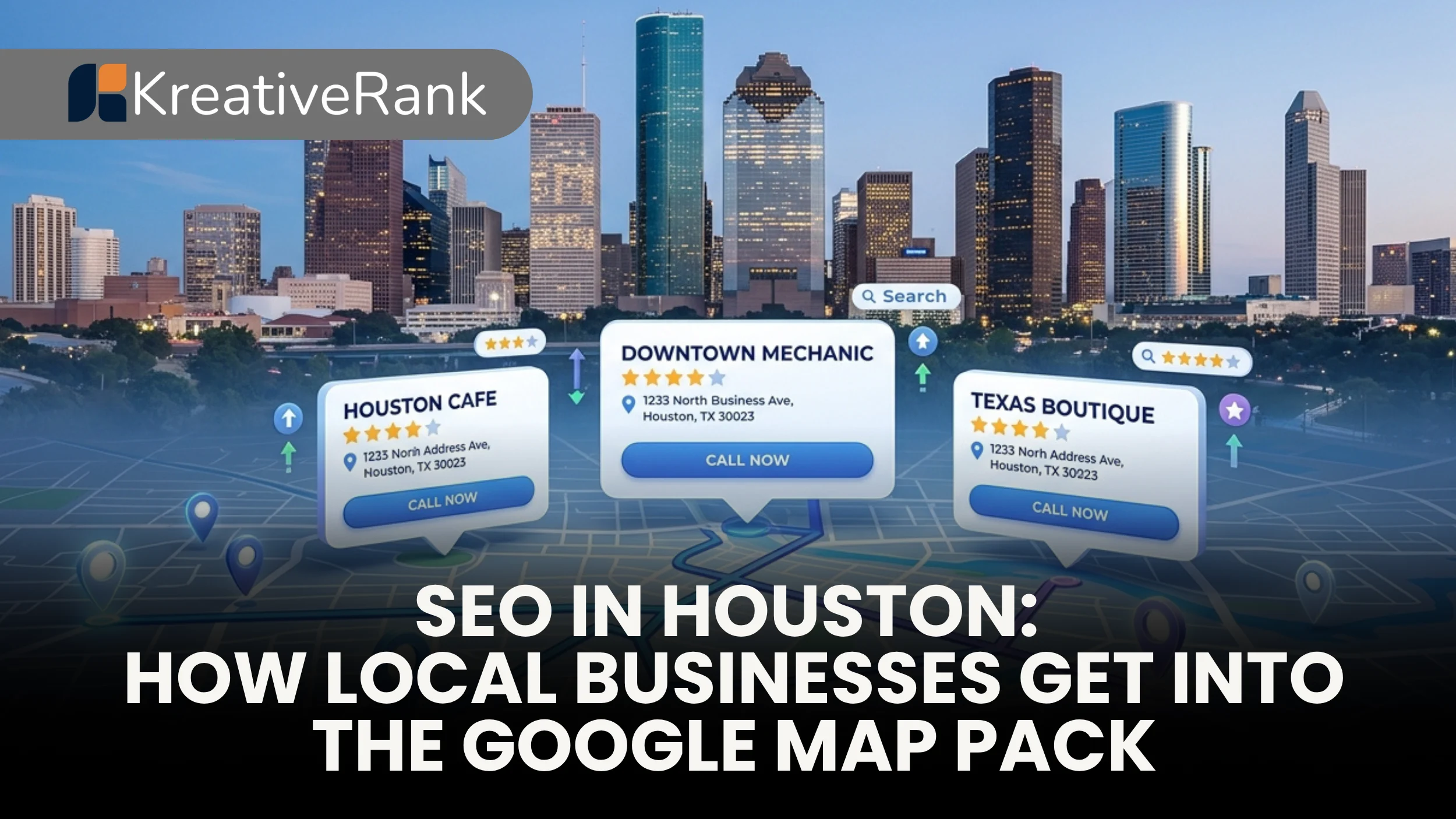
To get your Houston business into the highly coveted Google Map Pack, you must claim and fully optimize your Google Business Profile (GBP), maintain consistent NAP (Name, Address, Phone) citations across the web, and generate a steady stream of high quality customer reviews. Google’s local algorithm determines Map Pack rankings based on three core pillars: relevance, distance, and prominence. By combining a robust GBP strategy with localized on-page SEO and Answer Engine Optimization (AEO), Houston businesses can dominate local search results and drive high-intent foot traffic.
What is the Google Map Pack?
The Google Map Pack (frequently referred to as the Local Pack) is the prominent section of Google’s search engine results pages (SERPs) that displays the top three local businesses related to a user’s query, alongside a map pinpointing their locations.
For a highly competitive and sprawling market like Houston the fourth largest city in the U.S. with over 2.3 million residents appearing in these top three spots is absolutely crucial. Whether your business is located in the Energy Corridor, the Texas Medical Center, or suburbs like Katy and Sugar Land, the Map Pack captures over 40% of all local search clicks. It is the most valuable digital real estate for brick and mortar stores and service area businesses alike. If you are not in the Map Pack, you are essentially invisible to a massive segment of ready to buy local consumers.
The Three Pillars of Local SEO: Relevance, Distance, and Prominence
Google evaluates local businesses based on three primary ranking factors. Understanding how these work together often referred to as Relevance, distance, and prominence is the key to unlocking local search success. You can read more about this in Google’s official guidelines on improving local ranking.
1. Relevance
Relevance refers to how well a local Google Business Profile matches what someone is searching for. If a user searches for “best HVAC repair in Houston,” Google looks for businesses that explicitly state they offer HVAC repair services in that specific area.
- How to optimize: Ensure your GBP has the correct primary and secondary categories. Add detailed service descriptions, utilize relevant keywords naturally in your profile, and keep your business attributes (like "wheelchair accessible" or "women-owned") up to date.
2. Distance
Distance considers how far each potential search result is from the location term used in a search. If a user doesn’t specify a location, Google calculates distance based on what it knows about their current location via GPS or IP address.
- How to optimize: While you cannot change your physical location, you can ensure your address is perfectly accurate. For service area businesses (like plumbers or roofers), clearly define your service areas so Google understands your geographic reach across the Greater Houston area.
3. Prominence
Prominence is a measure of how well known a business is. Some places are more prominent in the offline world (like famous museums or landmark hotels), and search results try to reflect this. In the digital realm, prominence is heavily influenced by your online reputation, review count, and overall authority.
- How to optimize: Gather a high volume of positive Google reviews, build local backlinks, and ensure your business is listed in authoritative local directories. Industry experts continually analyze comprehensive local search ranking factors to determine that prominence is often the tie-breaker in competitive markets.
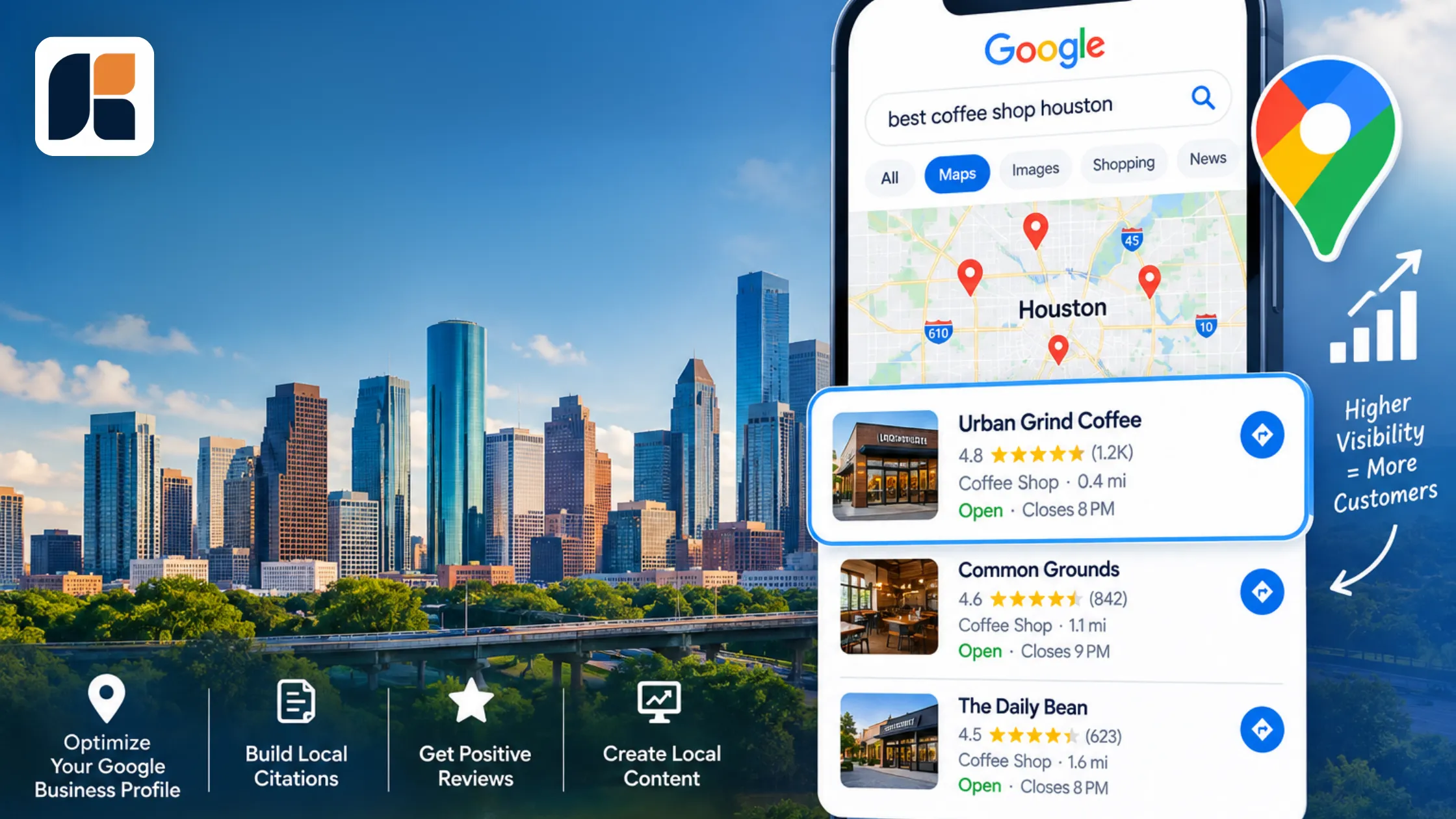
Step by Step Guide to Dominating Houston Local SEO
1. Claim and Optimize Your Google Business Profile
Your GBP is the absolute foundation of your local SEO strategy.
- Complete every field: Fill out your business name, address, phone number, website, hours of operation, and description. Leave nothing blank.
- Choose the right categories: Your primary category has the most significant impact on your rankings. Be as specific as possible (e.g., "Personal Injury Attorney" instead of just "Lawyer").
- Add high quality photos: Regularly upload photos of your storefront, team, and completed projects. Businesses with photos receive significantly more requests for directions and website clicks.
- Use Google Posts: Share updates, offers, and events weekly to keep your profile active and signal relevance to Google.
2. Build Consistent Local Citations (NAP)
NAP stands for Name, Address, and Phone number. Search engines use citations (mentions of your business across the web) to verify your business’s legitimacy. While they may not carry the same heavy ranking weight they did a decade ago, they remain a foundational trust signal for Google’s local algorithm.
- Audit existing citations: Use tools to scan the web for your business information. Look for duplicate listings, old addresses, or incorrect phone numbers that might be confusing search engines.
- Target industry specific directories: In addition to general directories like Yelp and Bing Places, seek out niche directories relevant to your industry (e.g., Avvo for lawyers, Healthgrades for doctors, or HomeAdvisor for contractors).
- Leverage Houston-specific platforms: Getting listed on local Houston websites, such as the Greater Houston Partnership, local neighborhood association pages, or Houston based business blogs, provides hyper local relevance that generic directories cannot match. Ensure your NAP is 100% consistent across all these platforms.
3. Implement a Review Generation Strategy
Reviews are a massive ranking factor for the Map Pack. According to Recent surveys on local search ranking factors, review signals (quantity, velocity, and diversity) are among the top competitive differentiators
- Ask for reviews: Implement an automated system to ask satisfied customers for reviews immediately after a service is rendered.
- Respond to all reviews: Engage with both positive and negative reviews. This shows Google and potential customers that you actively manage your business and care about customer feedback.
4. Optimize Your Website for Local Search (On-Page SEO)
Your website’s SEO directly impacts your Map Pack rankings. Optimizing your website is crucial for Improving your overall SEO visibility.
- Create location specific pages: If you serve multiple areas in Greater Houston, create dedicated landing pages for each (e.g., "Plumbing Services in Cypress," "Roofing in Spring").
- Embed a Google Map: Embed a map of your business location on your contact page.
- Use local schema markup: Implement LocalBusiness JSON-LD structured data to help search engines easily parse your business details.
- A strong local SEO campaign often starts with a high-converting website design in Houston that is mobile friendly and fast loading.
Answer Engine Optimization (AEO) for Local Search
Answer Engine Optimization (AEO) is rapidly becoming a cornerstone of local search strategy. As users increasingly rely on AI-powered search assistants such as Google’s AI Overviews, Apple’s Siri, Amazon’s Alexa, and ChatGPT the way they search is fundamentally changing. Instead of typing fragmented keywords like ‘Houston plumber,’ they are asking complete, conversational questions like, ‘Who is the most reliable emergency plumber near downtown Houston that is open right now?’
To optimize for Answer Engines, Houston businesses must adapt their content strategies:
- Target conversational queries: Shift your keyword research to focus on long-tail, natural language questions.
- Build comprehensive FAQ sections: Answer common customer questions clearly, concisely, and directly on your website. Use the 'Question-Answer' format, which AI models easily digest.
- Focus on entity building: Establish your business as a recognized digital entity. This means consistently linking your GBP, website, social media profiles, and local directory listings so that AI models can confidently connect the dots about who you are, what you do, and where you operate.
- Provide direct answers: When writing blog posts or service pages, start with a direct answer to the main topic (a BLUF - Bottom Line Up Front) before diving into the details. This structure is highly favored by AI extraction algorithms.
If you need expert help navigating these complex algorithms, consider partnering with Professional SEO services that get your business found on Google.
Frequently Asked Questions (FAQ)
Ranking in the Map Pack typically takes anywhere from 3 to 6 months, depending on the competitiveness of your industry in Houston, the current state of your website, and the age of your Google Business Profile.
You do not need a storefront, but you do need a valid address to verify your business. Service-area businesses (like plumbers, electricians, or mobile detailers) can hide their physical address on their GBP and display a service area instead.
You cannot pay for organic Map Pack rankings. However, Google does offer Local Services Ads and sponsored map listings, which appear at the very top of the Map Pack with an “Ad” or “Sponsored” label.
Very important. While your GBP is the primary driver, the organic authority of the website linked to your profile heavily influences your prominence. Earning local backlinks from Houston news sites, blogs, and partner businesses will significantly boost your Map Pack visibility.